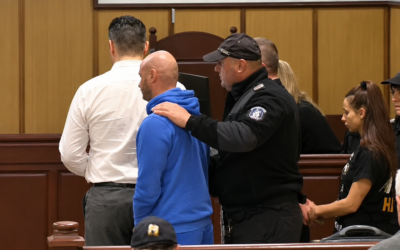
CAAI calls on the Bulgarian prosecution authorities to challenge the sentences in the Svishtov animal cruelty case and calls for harsher penalties, a review of the judicial procedure and legislative measures to protect animals from repeated abuse. CAAI’s official statement was also endorsed by 47 lawyers at the time of its submission.
On 20 October 2026, the District Court in Svishtov, a town in northern Bulgaria on the Danube River, sentenced Anita Vachkova to two years in prison and Detelin Avramov to two years and four months in prison.
The case concerns the systematic torture and killing of animals over a period of approximately ten years, from 2014 to May 2024. The judgment covers 81 separate acts of animal cruelty. However, according to CAAI’s assessment and count of the evidence submitted, hundreds of animals were killed.
The crimes were uncovered following an investigation by CAAI (Campaigns and Activism for Animals in the Industry), a Bulgarian animal protection organisation. The evidence collected reveals cruelty that is difficult to describe in words – the torture and killing of animals turned into a means of producing and selling video content intended for sexual gratification.
In our view, the sentences imposed are disproportionate to the scale, duration and exceptional cruelty of the crimes.
We therefore submitted a formal legal statement to the prosecution authorities, urging them to challenge the judgment before the appellate court.
Read the full text of our legal statement here (in Bulgarian).
The statement has so far been endorsed by 47 lawyers, legal professionals and former judges. The list of supporters is available here.
(Other lawyers and legal experts who wish to endorse the statement may submit their names to .)
Why are we calling for harsher sentences?
It is important to explain two aspects of Bulgarian criminal law that directly affect the severity of the sentences imposed.
Firstly, offenders are tried under the criminal law applicable at the time the offences were committed, rather than necessarily under the law in force at the time of sentencing.
In 2025, Bulgaria significantly increased the penalties for animal cruelty. However, harsher criminal provisions cannot be applied retroactively. As the crimes in the Svishtov case ended in May 2024, the court applied the legislation in force at that time, following the amendments adopted in 2023.
Even these earlier legal provisions, however, allow for significantly harsher sentences.
Secondly, when a person is convicted of multiple criminal offences, the individual sentences are not necessarily added together.
Anita Vachkova received two separate sentences of three years’ imprisonment each – one for cruelty to animals resulting in their deaths, and the other for the production and distribution of pornographic material.
The case was heard under a shortened trial procedure provided for under Bulgarian criminal law. The defendants admitted the facts set out in the indictment and agreed that evidence relating to those facts did not need to be presented at trial. Under Bulgarian law, this procedure requires the sentences imposed to be reduced by one third. As a result, each of Vachkova’s individual sentences was reduced to two years.
But why was her overall prison sentence two years rather than four?
Because, in such circumstances, the Bulgarian Criminal Code requires the court to impose a single overall sentence equivalent to the most severe of the individual sentences, rather than adding them together.
Under the same mechanism, Detelin Avramov’s two individual sentences of three years and six months each were reduced to two years and four months each. This also became his overall prison sentence.
This is a statutory rule, rather than an arbitrary decision by the court. However, the law allows the overall sentence to be increased by up to 50% – an option the court did not exercise. Furthermore, the initial sentences for each individual offence could also have been more severe.
We also question why the woman who directly carried out the torture and killings received a lighter sentence than the man convicted of instigating and aiding these acts.
We are not dealing with an isolated act of violence, but with organised criminal activity involving advance planning, the procurement of animals, the construction of devices used to torture them, and the recording and sale of videos.
The written reasoning behind the first-instance court’s judgment has not yet been published. However, CAAI believes that the scale, systematic nature, exceptional cruelty, sexual purpose and financial motivation of the criminal activity warrant a thorough review of the sentences by the appellate court.
Has the true severity of the pornographic content been adequately assessed?
According to CAAI’s analysis, the entire operation involving the recording of animal torture and killings served a sexual purpose. This relates to what is known as a crush fetish – content in which actual violence against animals is used to induce sexual arousal.
However, the charges relating to the production and distribution of pornographic material covered only 15 video files.
We urge the prosecution authorities to examine whether the remaining recordings submitted as evidence also fall within the statutory definition of pornographic material under Bulgarian law, which encompasses sexual sadism, and whether they have been adequately assessed from a criminal law perspective.
We also believe that, when determining the appropriate sentences, the specific nature of these materials must be taken into account: they were produced through the actual infliction of suffering and death on animals.
Our request for a review of the remaining recordings is separate from our call for an increase in the sentences already imposed.
We are also calling for a review of the judicial procedure
CAAI has formally referred concerns regarding the selection of lay judges to the Inspectorate of Bulgaria’s Supreme Judicial Council, the body responsible for inspecting the work of judicial authorities.
Lay judges are members of the public who sit alongside professional judges and participate in judicial decision-making in certain criminal cases under the Bulgarian legal system.
According to official electronic records, on 16 October, eight consecutive procedures for selecting lay judges were conducted within just six minutes and 28 seconds – on a Friday afternoon, immediately before the court hearing scheduled for the following Tuesday.
We are calling for clarification of the reasons behind the repeated selection procedures, the grounds on which the initially selected lay judges did not participate, and whether those ultimately appointed had a genuine opportunity to familiarise themselves with the evidence in such an extensive case.
We are not making allegations of wrongdoing in advance of an investigation. We are calling for a formal review.
What happens when the convicted offenders are released from prison?
This case raises another important question: how can we protect animals from individuals who have already committed such acts of cruelty?
A prison sentence has a defined duration. But what happens once that sentence has been served? What guarantees are there that someone who has systematically tortured and killed animals will not once again gain access to defenceless beings?
CAAI believes that Bulgarian legislation should empower courts, when convicting individuals of animal cruelty, to impose an additional ban on acquiring, owning, possessing and keeping animals, as well as on working with animals or engaging in activities involving their care or direct supervision.
Such a ban should be imposed for a specified period or, in particularly serious cases where a risk of repeated abuse has been established, for life. Clear enforcement and monitoring mechanisms must also be put in place.
CAAI intends to bring this legislative proposal forward for public debate and discussion with the relevant Bulgarian institutions. Such a measure could not be applied retroactively in the present case, but it could protect future victims.
Justice should not merely punish acts of cruelty that have already been committed. It should also help prevent the next crime.
Justice does not end with a court judgment
CAAI urges the prosecution authorities to lodge a formal challenge against the first-instance judgment within the statutory deadline of 4 November 2026, seeking harsher sentences.
We can no longer save the animals that were tortured and killed. But we can insist that their suffering is not trivialised and that the state takes the necessary steps to protect other animals.
CAAI will continue to monitor the case and advocate for justice, accountability and effective measures to prevent animal cruelty.
Lawyers, legal professionals and former judges who have endorsed CAAI’s statement
The statement has been endorsed by:
- Martin Petrov – Lecturer in Criminal Law
- Marieta Karadzhova – Lawyer
- Spas Ivanchev – Lawyer
- Stefan Atanasov – Lawyer
- Mariyan Markov – Lawyer
- Stoyan Barzakov – Lawyer
- Kristina Petkova – Lawyer
- Radan Kanev – Lawyer
- Miltana Peeva – Lawyer
- Violeta Ivanova – Lawyer
- Ivan Filipov – Lawyer
- Desislava Filipovska – Lawyer
- Lidiya Popova – Lawyer
- Nikola Ivanov – Lawyer
- Dragomir Simeonov – Lawyer
- Lyubomir Takov – Lawyer
- Ralitsa Filipova – Lawyer
- Marina Rupova – Lawyer
- Mihaela Stoeva – Lawyer
- Ivan Valchev – Lawyer
- Milena Kalcheva – Lawyer
- Stefan Fikov – Lawyer
- Lidiya Andreeva – Lawyer
- Lora Gurmeva – Lawyer
- Hristo Hristov – Lawyer
- David Vardanyan – Lawyer
- Yanko Georgiev – Lawyer
- Evgeniya Dimova – Lawyer
- Tsvetomira Ivanova – Lawyer
- Velina Angelova – Lawyer
- Aleksandar Kodzhabashev – Lawyer
- Irina Paleva – Lawyer
- Simona Takova – Lawyer
- Martin Kantarev – Lawyer
- Pavel Filipov – Lawyer
- Denitsa Veselinova – Lawyer
- Lachezar Takov – Lawyer
- Asen Asenov – Lawyer
- Denislav Asenov – Lawyer
- Tonya Latovska – Lawyer
- Anna Borisova – Lawyer
- Georgi Gergov – Lawyer
- Viktor Barchev – Lawyer
- Lachezar Bosakov – Lawyer
- Karina Stefanova – Legal Counsel
- Zhara Mineva – Legal Professional
- Stanislava Evgenieva – Legal Counsel