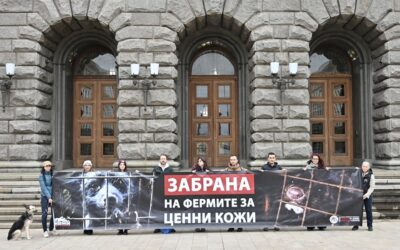
Following CAAI’s public statement, now endorsed by 47 legal professionals including lawyers and formal judges, and complaints submitted by concerned citizens, prosecutors in Svishtov, Bulgaria, have appealed the sentences imposed on Anita Vachkova and Detelin Avramov, seeking harsher penalties.
This is an important step. The case will now be reviewed by a higher court. The prosecution has clarified that it had sought sentences close to the statutory maximum during the original trial.
Why Could the Prison Sentences Be Significantly Longer?
For each of the two criminal offences, the court initially imposed a sentence of three years’ imprisonment on Vachkova and three years and six months on Avramov.
Because the defendants admitted the facts set out in the indictment, Bulgarian law required a one-third reduction in their sentences. This resulted in two years of imprisonment for Vachkova and two years and four months for Avramov, both to be served in prison rather than suspended.
Under Bulgarian law, the sentences for the two offences are not automatically added together. Instead, the court must impose a single combined sentence equal to the more severe of the individual sentences.
However, the court could have imposed higher initial sentences and increased the combined sentence by up to 50%.
If the individual sentences are set close to the statutory maximum and the combined sentence is increased under Article 24 of the Bulgarian Criminal Code, the final prison term could reach six years.
The stricter penalties introduced through legislative amendments in 2025 cannot be applied retroactively.
Why Does the Pornography Charge Cover Only 15 Videos?
According to CAAI’s legal analysis, all videos depicting the torture and killing of animals were produced for sexual purposes, specifically for the so-called crush fetish, in which the real suffering and death of animals are used to induce sexual arousal.
Bulgarian law explicitly includes sexual sadism within its definition of pornographic material. We therefore call on prosecutors to examine whether the remaining recordings also meet this legal definition.
Another unanswered question is why the person who directly committed the acts received a lighter sentence than the individual who instigated and assisted in their commission.
We are also awaiting the outcome of an inquiry by the Inspectorate of Bulgaria’s Supreme Judicial Council, the body responsible for oversight of the judiciary, into eight consecutive jury-selection procedures held immediately before the trial. These procedures concerned the selection of lay judges, who sit alongside professional judges in certain Bulgarian criminal cases.
We thank all the citizens and legal professionals who have stood up for justice.
Appropriate sentences matter not only as punishment for crimes already committed, but also as a means of preventing future violence.
Additional Information
(Official statement by the Bulgarian Prosecutor’s Office.)